
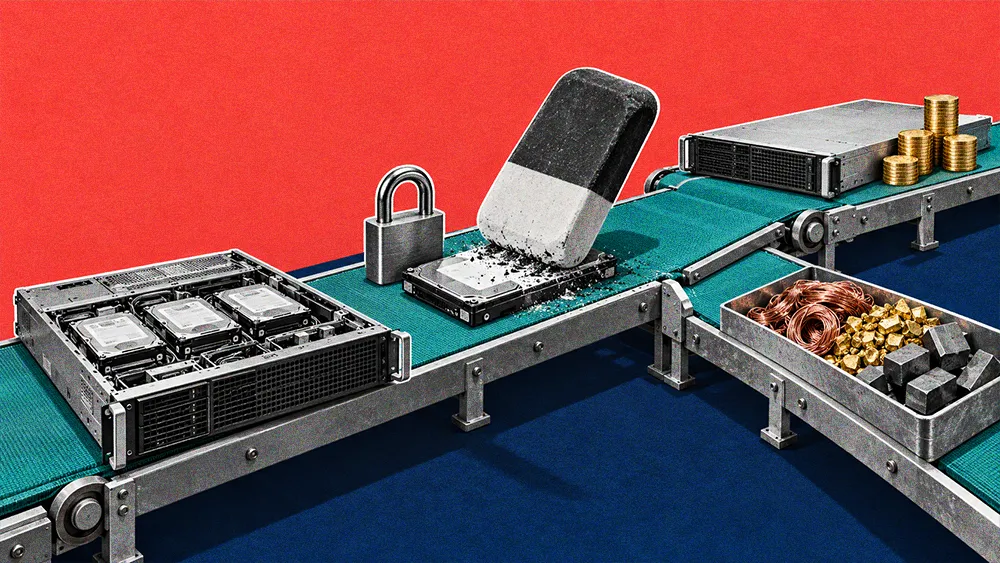
Transparency and cybersecurity are ever present, even in the recovery of rare earth magnets, critical minerals, and the reuse of electronics, GPUs, and other things. We have to perform to those standards on everything we're doing on both sides of our house.
 John ShegerianChairman & CEO @ ERI
A server leaving a data center still has drives on it holding data that has to be provably destroyed, and a chassis around them holding copper, gold, and rare earth magnets that are hard to buy and expensive to replace. Those two jobs have sat with different teams on different timelines, and the pace of AI infrastructure refresh is collapsing them into one process. Equipment is coming off the floor fast enough that retirement volumes now outrun the forecasts, and the chain of custody over what leaves a facility now gets the same scrutiny as what gets recovered from it.
John Shegerian is Chairman and CEO of ERI, the materials recovery and IT asset disposition company he co-founded in 2002. It processes material at eight certified US locations and serves every zip code in the country. ERI was the first company in its industry to hold SOC 2 Type I and II certification, covering both security and data protection. Shegerian also holds a cybersecurity certification from Harvard, completed MIT Sloan's cybersecurity program, and co-wrote a book on hardware hacking.
"Transparency and cybersecurity are ever present, even in the recovery of rare earth magnets, critical minerals, and the reuse of electronics, GPUs, and other things. We have to perform to those standards on everything we're doing on both sides of our house," says Shegerian. Half of what ERI handles comes back for resale and half gets destroyed, and both halves move under the same chain of custody. What's changed with data center work is the tolerance for discrepancy, and that tolerance is now effectively zero.
Reconciliation on the floor
Enterprise IT asset disposition has always involved an inventory count. For a fleet of laptops, a small variance was survivable. In a data center, it isn't. An unaccounted-for hard drive is considered an incident, and the operator needs to know whether it went missing inside their own building or somewhere downstream.
ERI now offers customers the option to have ERI teams sent into the customer's building to do that work there. They wipe the drives on site and register each asset as they go, using optical and software tools that capture the record while the hardware is still in the rack. "They love that we come on site and we do data sanitization, but also manifest reconciliation with them," Shegerian says. "Therefore they know what they have and they know any voids or any missing pieces." The count and the equipment stay in the same room until both are settled.
Getting inside a customer's facility at all depends on a certification few recyclers hold. ERI is the only processor at its size carrying that certification, and the audit behind it covers every facility and practice in the company. "SOC 2 certification isn't just some fun test you take. It literally locks down all of your facilities and your practices," Shegerian adds. "It's a serious endeavor, it costs a lot of money." For an operator whose data governance obligations follow every asset out of the building, that certification is the price of entry.
Shred it or sell it
A data center taking servers out of service hands ERI a mix of hardware that still works and hardware that's worth more broken down. The scrap side goes through the shredders, where the critical minerals and rare earth magnets come out and go back into manufacturing, a stream ERI feeds through a supply agreement with Cyclic Materials on the magnet side. Whatever still runs gets tested and resold to another operator.
The customer decides where the line between those two falls. Sustainability targets pull toward recovery and resale value pulls the other way, and Shegerian's larger accounts ask him to settle the two in a single arrangement. "There's the other side where they say, 'Hey, harvest as much as you can out of our data center and help defer our recycling costs by reselling it and doing a profit share with us,'" he adds. What the secondary market pays that week decides how far those proceeds go.
Drawing that line requires pricing no single operator can see. ERI moves equipment through a network of buyers who resell it into other data centers, and that transaction volume shows it what used hardware is worth. "Because they come to us for this advice, we're constantly updating it," Shegerian says. "It's become less of an annual or a quarterly thing." Operators now buy that view along with the processing, and they use it to decide what to keep running and what to sell.
Recovery as domestic supply
The metals recovered from shredded servers and drives often go back to manufacturers who are short of those exact materials. Material pulled out of hardware already inside a country typically stays there, and recovery has become one more source for a data center build-out to draw on.
Much of the pressure to keep recovery inside national borders traces back to a single point in the supply chain. "The next real choke point China controls is the monopoly on rare earth magnets and critical minerals that they have," Shegerian adds. "They built it up over 50 years." This monopoly is why governments in South Korea, Japan, Vietnam, Australia, and India have come to him asking how to recycle their own electronics and keep what they recover inside their borders. Manufacturers want the same thing commercially, buying back the material from their own returned products. ERI can open a processing facility in four to six months, and its expansion follows that demand.
The material those governments and manufacturers want back is hardware an operator is currently buying. The equipment going in now is part of the material supply for whatever replaces it, and how much of it ever comes back depends on choices made before it ships. "Basically hiding in plain sight, in the palm of your hand, is the answer to sovereignty and domestication," Shegerian concludes. "And every country wants that now."