
Now you can have the power source next to the data center. That creates a local ecosystem that is very sustainable.
 Husam MohammedMEP Design Director @ Jacobs
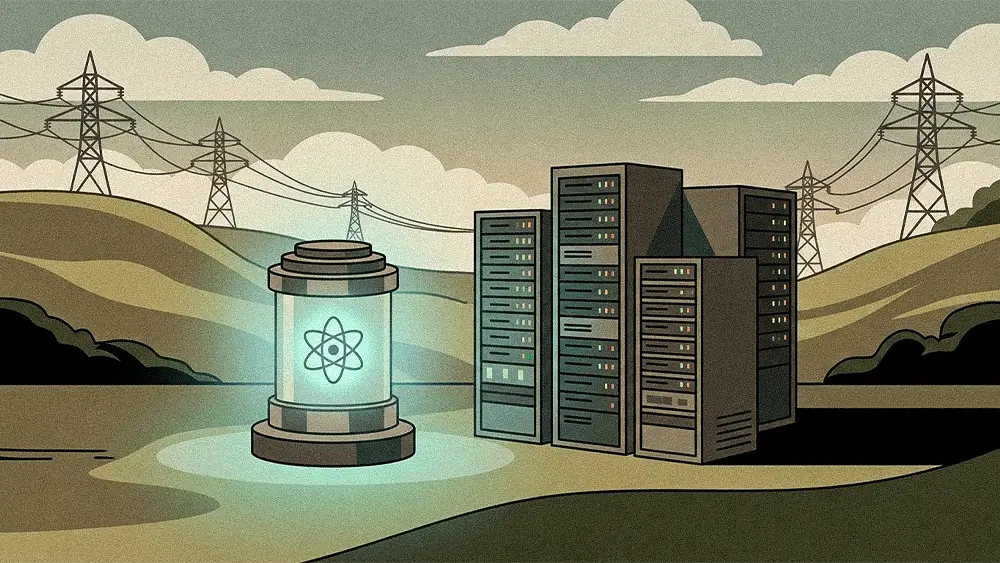
Data centers running AI workloads need far more electricity than conventional computing requires, and large volumes of water to carry away the heat the servers generate. When the local utility can't deliver that much power and water fast enough, developers generate their own electricity and produce their own water on site rather than wait years for a grid connection. Small modular reactors are one option. A compact nuclear unit installed beside a data center can power the servers, run a desalination plant for the water, and pass its leftover heat into equipment that converts it into cooling.
Husam Mohammed is MEP Design Director at Jacobs, a global engineering and professional services firm that designs and delivers major infrastructure programs. He's based in Riyadh, where his team designs data centers and giga-projects across Saudi Arabia, a market with limited fresh water and constant pressure on the power grid. He rejoined the firm after nearly 11 years there earlier in his career, having helped deliver projects across offices on several continents.
"Now you can have the power source next to the data center. That creates a local ecosystem that is very sustainable," Mohammed says. A campus built beside its own reactor doesn't need the transmission lines, substations, and access roads that link a remote site to a distant power plant. It can also produce water on the same ground, which is what solves the cooling problem.
Power buys water
Two questions decide whether a data center project happens at all. "If a client comes and says I want to build a data center, the first thing we ask is, do you have power? And do you have the water?" Mohammed says.
Power gets answered first. A site with electricity can make its own water, because desalination and recycling both run on power. A site with water has no way to turn it into electricity. That's why the reactor, not the treatment plant, sits at the center of the design.
Both questions have gotten harder because of a change in the hardware. Racks in AI facilities now run hotter than moving air can handle, and the liquid systems that replace air cooling put water directly against the equipment instead of into a tower at the far end of the process. That moves water further up the list of things a site has to secure before it breaks ground. "Now with AI, the cooling load for these data centers is extremely high. So air-cooled solutions on their own are no longer sufficient for these densities," Mohammed notes.
A reactor's heat drives a desalination unit, and the site's wastewater can be cleaned and used again instead of discharged. Across the Gulf, that thinking shows up in water security investment rising alongside compute capacity. "You can have a nearby desalination plant that includes water reuse, black water recycling and gray water recycling. You can also use absorption chillers," he says.
Absorption chillers turn the reactor's waste heat into cooling. Most chillers use electricity to produce cold air. Absorption chillers use heat, so what the reactor throws off becomes the input that cools the servers. Two problems cancel each other out. Operators who pair that setup with closed-loop liquid cooling cut their water draw and their electricity draw at once. "Because you have a demand for cooling and you have waste heat at the same time, you can take some of that heat to absorption chillers and produce your own cooling," Mohammed adds.
Building without reactors
Small modular reactors are years away. The data centers are going up now. None of the campuses Mohammed's team is designing will have a reactor to draw on when they open, and the first units in Saudi Arabia are not expected to run until sometime in the 2030s at the earliest.
Developers aren't waiting. Mohammed describes local builders putting up facilities with capacity already committed to large cloud providers before the doors open, the financing settled ahead of construction. Every project built that way runs on whatever is available today, which in practice means the grid or gas. Interest in reactors is real, and the volume of conditional offtake agreements between data center operators and reactor developers has nearly doubled in under two years. These are advance commitments to buy power that doesn't exist yet.
That leaves an open question about what the market looks like when the first reactors finally arrive. If conventional supply has already served most of the demand, the case for building reactors weakens. Mohammed expects the opposite, that demand will outrun the grid and make the alternative worth paying for. "There needs to be this balance where you have so much investment happening in data centers, but at the same time the infrastructure is not able to meet the demand. So at that point SMRs would be very attractive," he adds. The buyers those reactors would serve are already feeling the pressure. In a survey of 300 executives, MIT Technology Review Insights found that nearly all expect their AI-related energy use to climb over the next year and a half, and two-thirds had already absorbed energy cost increases of 10% or more.
Connecting a large facility to the grid takes years in most major markets, and long connection delays have made the utility something developers work around. Gas generators on site have filled most of that gap so far, because they can be installed quickly. Reactors take longer to build and longer to license, which is why they show up in long-range plans while the buildings finished this year run on something else.
Rules lag hardware
The engineering is further along than the paperwork. Buying a reactor, moving it across a border, licensing it, handling the waste, and selling the surplus all depend on rules that are still being written, and each one sits with a different government body. "There's a lot of discussion that needs to happen between these technology leaders about the procurement of these, how do you install them, how do you run them, operate them," Mohammed says.
Where a country can buy from gets settled before any of that. Nuclear technology only crosses borders under a formal agreement between the two governments, and each supplier country requires its own. A buyer that has negotiated with one has no access to another's reactors until it negotiates again, which can take years. So the list of who can sell into a given market is shorter than the list of who builds reactors, and the most advanced design in the world may not be the one on offer.
Staffing is another open piece. Running a reactor takes licensed operators, and in early projects those people usually arrive with the technology instead of being hired locally, which makes staffing part of what a developer buys. Waste is a third. Until there's a clear process for disposing of it, no private developer can treat a reactor the way it treats a generator or a chiller. Ontario shows how long the sequence runs once the rules are settled, with a reactor under construction at Darlington after years of regulatory work before any concrete was poured. "They have to talk more often, they have to dedicate the budgets and they have to streamline the process in terms of governance and regulations," Mohammed adds.
Governments have their own reasons to move slowly. A private reactor changes who controls generation inside a country's borders, which raises questions about energy security that a gas turbine never does. The rule with the clearest effect on the economics is what happens to leftover power, because a site producing more than it uses needs an agreement with the utility about selling the surplus back, and those terms decide whether building your own supply is an expense or a source of income.
Utilities want in
A data center that makes its own power stops being a customer. Large industrial sites are among the most valuable accounts a utility has, and losing several of them takes revenue off the books. Mohammed expects utilities to want a stake in the reactors instead of watching the business go. "If these power companies are worried about the revenue that comes with the power connection and the grid, they may want to be part of the SMRs because they might lose customers from grid consumption to the SMR," Mohammed says.
The pattern shows up in how projects get planned, with a rising share of new facilities including some form of onsite generation. The same math works elsewhere. A development with a hotel, a mall, and a few residential towers draws enough steady load to justify its own reactor, and it can sell the surplus back on the same terms.
The grid these sites would be leaving is under more strain than it used to be. Summers have gotten hotter across the Gulf and Europe, and a house that runs air conditioning can use roughly twice the electricity of one that doesn't. Every one of those homes draws from the same supply the data centers are waiting on.