
Data Primacy: Why Government's AI Ambitions Run Through Its Data Architecture
Bill Wright, Head of Government Affairs at Everpure, says federal agencies keep calling data their most valuable asset while their systems still treat it as a byproduct of individual applications.


Plenty of people in government talk about how much data matters. The agencies that turn that talk into architecture, that genuinely put data first, will be the ones deploying AI with confidence, running leaner, and keeping the public’s trust while they do it.

Every major shift in computing has really been a shift in architecture: a change in how hardware, software, networks, and data relate to one another. Mainframes gave way to client-server, which gave way to the cloud. Through all of it, one assumption stayed put: Data existed to serve the application. The application sat at the center, and data came second.
In government, that assumption has had decades to settle in. Agencies built their systems one program at a time, and the public sector now runs on thousands of applications, each holding its own data, its own definitions, and usually several copies of both. The outcome is an odd contradiction. Agencies say, over and over, that data is essential to their missions, and they keep standing up infrastructure that treats it as a byproduct.
AI is what’s finally exposing that contradiction, because an AI system is only as useful as the data feeding it, and a great deal of government data is still trapped inside the applications that created it.
The cost of a fragmented foundation
As applications multiplied, so did data, and the meaning of that data splintered along the way. Pull a piece of data out of the system that created it and it often becomes unreadable without the context that lived in that system. Making it usable somewhere else means extracting it, transforming it, and reloading it into a new shape, which is both slow and expensive.
In the private sector, this played out through decades of application sprawl. The original vision behind large-scale ERP systems was a single enterprise application capable of modeling every business process within one unified semantic framework. That vision fractured as organizations carved out specialized domains and adopted best-of-breed tools. They gained speed and feature innovation. They lost semantic coherence across functions. SaaS accelerated the pattern further, and each new application brought its own definitions, its own data copies, and its own integration layer.
Government followed the same arc, with an added layer of complexity. Agencies are autonomous and mission-focused by design, so application sprawl didn’t just fragment data across tools. It fragmented data across entire institutions. The same person can mean different things to the different agencies that serve them. A veteran’s information looks one way in VA systems and another in the Department of Defense’s. Across agencies, the same taxpayer or claimant or enrollee gets reassembled again and again, usually through one more copy, one more spreadsheet, one more reconciliation meeting. Each reassembly is a place where errors creep in, and in government an error can mean getting a decision about someone’s life wrong.
So the accuracy bar in the public sector sits much higher than the usual talking points admit. In a business, “garbage in, garbage out” costs money. In government it costs trust. In high-stakes public sector applications—such as benefit adjudications—even a 95 percent accuracy rate leaves 5 percent of citizens subject to life-altering errors. Feed AI inconsistent data and you get inconsistent answers, and inconsistent answers chip away at the legitimacy that decisions need to hold up when they reach the people they affect.
How we got here
It wasn’t supposed to turn out this way. About seven years ago the Office of Management and Budget published the first Federal Data Strategy, with a vision of data managed as a strategic asset across the whole of government. While the strategic intent was sound, implementation encountered persistent architectural and structural barriers across autonomous agencies. Agencies are autonomous and mission-focused by design, so modernization followed the path of least resistance, with each office choosing the best tool for its own job. They gained speed and lost a shared vocabulary in the bargain.
That's roughly how the federal government ended up with the patchwork it's still sorting out: sprawling, lightly governed stores of data scattered across legacy systems, clouds, and SaaS platforms, copies sitting everywhere, and a thicket of rules about what can be shared with whom. Each new wave of technology piled on more data without disturbing the assumption underneath it. The application remained primary. Data remained secondary. And the semantic layer, the meaning of data and its relationships, stayed locked inside the application.
For a government trying to put AI to work at scale, this has become a serious obstacle.
AI inverts the hierarchy
The federal government has, to its credit, made AI a priority. America’s AI Action Plan treats AI adoption as a national goal and names data itself as a capability the government has to get right. Agencies are already in motion. The Department of Energy stood up its Genesis Mission for AI-driven research, the Department of Health and Human Services laid out a strategy to expand AI in areas like patient data analysis and drug development, and the Technology Modernization Fund is backing AI projects at agencies across government.
Ambition alone won’t get them there, though. Federal IT leaders have started making a point that deserves more attention: when agencies try to scale AI and hit long security reviews, ballooning costs, and pilots that never graduate, the trouble usually gets blamed on governance when the real culprit is infrastructure. Governance writes the rules. The data architecture decides whether anyone can actually play. More than a few agencies have learned the unglamorous lesson that you have to get slow with your data before you can get fast with AI.
That changes the question leaders should be asking. For IT leaders, AI transforms the architecture question from 'What can we automate?' to 'What can our agents accomplish for the mission?' When the application was the focus, the work was about optimizing tasks. When data becomes the focus, the work is about outcomes. This is a genuine change of model, not a refinement of the old one.
Data primacy
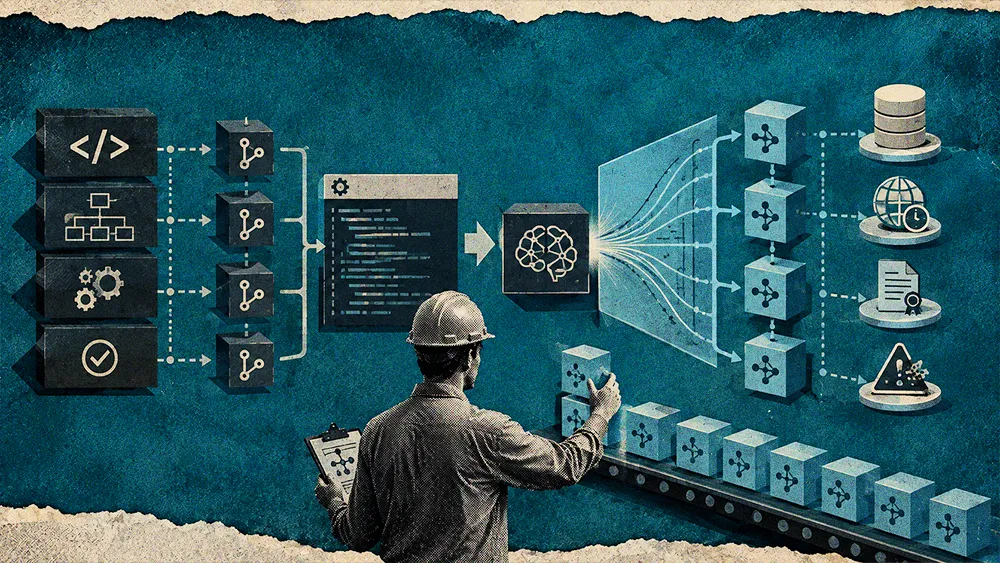
Scaling AI responsibly across government calls for a data-centric architecture, one where data comes first and applications follow. Data describes itself. Real-time data counts for more than stale copies. And every environment, whether operational, analytical, or agentic, works from the same authoritative source. In this model, data systems of operation and systems of record become the core foundational asset, and applications read from or write to those systems of record rather than storing authoritative information on their own. We call this data primacy. As we’ve argued elsewhere in our discussion of putting data first, organizations increasingly need architectures where data remains the enduring asset and applications become interchangeable layers built around it. Three principles hold it together, and each speaks to something the public sector is already wrestling with.
The first is that meaning has to travel with the data instead of living inside the application. Operational data should carry enough context to be understood outside the system that produced it, which means building semantic descriptions alongside data and recording the relationships that define how a piece of data connects to everything else in the environment. A record should maintain consistent semantic meaning whether an agent encounters it at one agency or another—wherever inter-agency sharing is legally authorized and governed by privacy safeguards. That's what lets AI reason over the data accurately, and it's the basis for automation a government can audit and defend.
The second is that data should be conserved rather than copied. Agencies have been trained to spin off a new copy for every system, every analytics environment, every AI experiment. Data primacy reverses the reflex. A single governed, secured, well-described source of real-time data can serve every application and every agent. Real-time data is more valuable than old data, and a system of record can’t be controlled by a single group; it has to be centrally governed as an enterprise resource. For government the benefit reaches accuracy, cost, and security at once, since every extra copy is one more attack surface, one more compliance headache, and one more version of the truth waiting to drift.
The third is that governance belongs at the data layer. The old approach ties access to particular applications through role-based controls. But agents range across many systems at the same time, which is precisely the case those controls were never built for. As agencies stand up Zero Trust, access needs to become contextual: shaped by the nature of the data, the identity of the agent asking, and the purpose behind the request. Governance moves from something bolted on at the end to something built into the structure.
A foundation worth funding
This is the point where policy and architecture meet. If the aim is a government that uses AI securely and in service of the public, the most valuable investments are the ones made lowest in the stack. Modernization funding—whether through the Technology Modernization Fund or core appropriations—delivers the highest return when investments target foundational, interoperable data readiness alongside pilot applications.
This is the work we've been building toward at Everpure for years: first by handling the complexity of storing data at scale, and now with an architecture that helps organizations find, classify, and make sense of data across their whole estate, on premises and in the cloud, with policy and meaning that follow the data wherever it goes. The goal is to keep what already works while moving toward something sturdier and more efficient underneath, a data-first foundation ready for the agents that will touch more and more of the work.
Earning trust in the AI era
AI is reshaping how the public sector serves people, and the ripple effects reach every part of the organization. Data stewards, CIOs and CDOs, infrastructure leaders, and the workforce keeping older systems running will all see their roles shift as AI changes what the work looks like and where the decisions get made. All of it starts with the data, though: data that carries its own context and meaning, that is governed and secured, that people across an agency can reach, and that an official can stand behind when a decision affects a citizen.
Plenty of people in government talk about how much data matters. The agencies that turn that talk into architecture, that genuinely put data first, will be the ones deploying AI with confidence, running leaner, and keeping the public’s trust while they do it.