
Part 2: What Keeps a Promising Banking AI Demo From Making It Into Production?
An Everpure-hosted panel featuring Options Technology VP Andrea Moccia and financial services infrastructure leaders laid out the recurring failure patterns that trap AI pilots in permanent purgatory, and the architectural decisions that let a handful of firms break through.
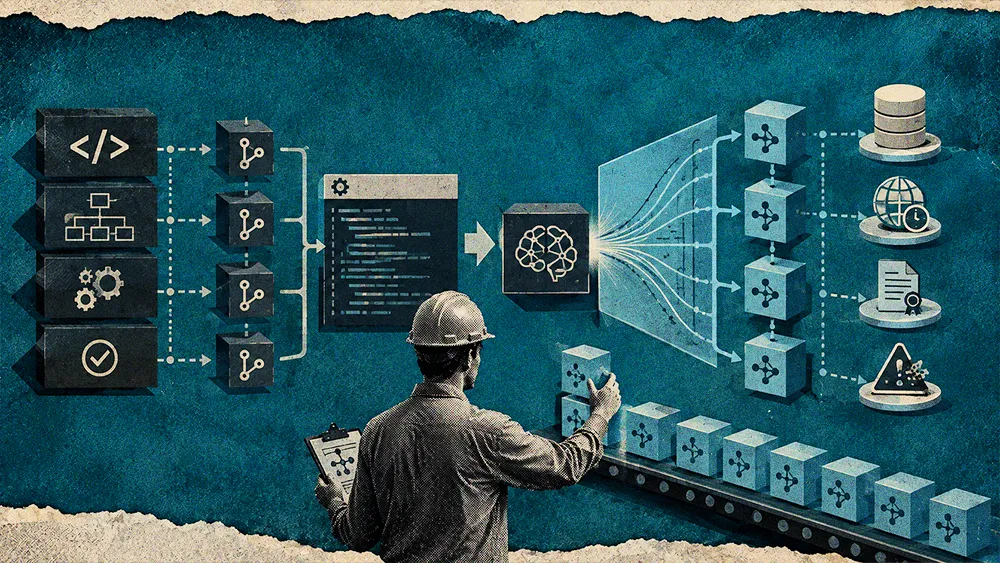

If you look at the AI graveyard today, 95% of the time it wasn't the model's fault. It was everything around it. People call it the harness, but it goes beyond that. Your data infrastructure, pipelines, your tests, your observability, your security. The good news is you don't have to build something new. Integrate AI into the systems you already have.

The statistic has become industry furniture at this point: more than half of AI proof-of-concept projects never make it into production. IDC research found that 88% of AI proof-of-concept projects never reach widescale deployment. S&P Global's 2025 survey put the average abandonment rate at 46% before production. The figures vary by study, but the direction is consistent. Organizations are investing heavily in demonstrating what AI can do and struggling to make it operational.
A panel discussion recorded at Everpure's Accelerate summit in Las Vegas brought together practitioners who see this failure pattern from the inside. Andrea Moccia, VP of AI and Data at Options Technology, a technology partner serving more than 600 financial institutions including investment banks, hedge funds, and fund administrators, joined Everpure financial services leaders to dissect what separates the organizations that reach production from the ones stuck in what the panel repeatedly called "POC purgatory."
The diagnosis was unanimous: the model is almost never the problem.
The graveyard isn't full of bad models
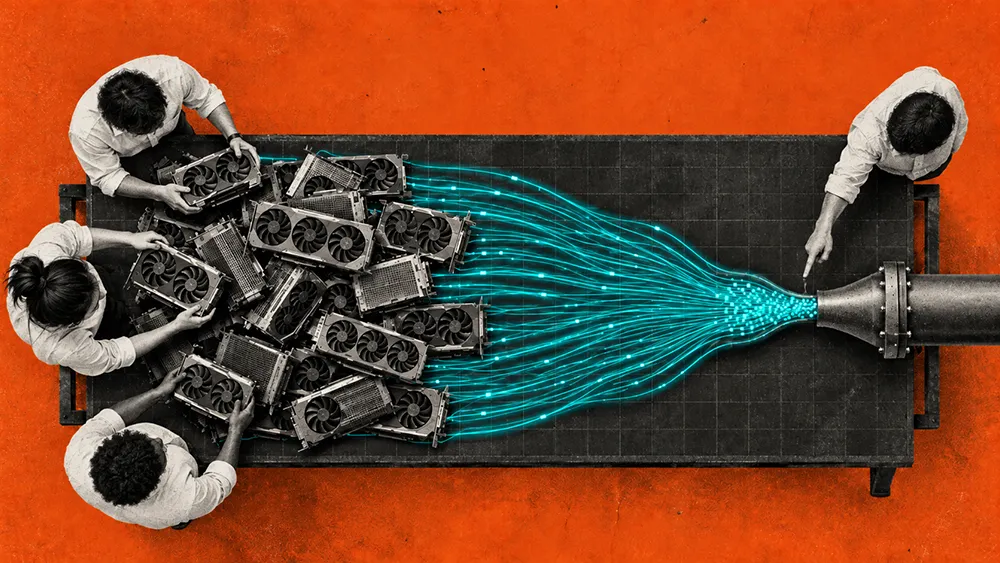
The panel's sharpest early insight came from the infrastructure side. When AI projects fail in financial services, the postmortem rarely points to the model itself. The algorithms worked. The outputs were accurate. The demo landed. What collapsed was everything around the model: the integration into existing business processes, the infrastructure to support production-scale workloads, and the data architecture required to feed the system reliably.
"If you look at the AI graveyard today, 95% of the time it wasn't the model's fault," said Richard Galvez, Everpure's Director of Applied AI. "It was everything around it. People call it the harness, but it goes beyond that. Your data infrastructure, pipelines, your tests, your observability, your security. The good news is you don't have to build something new. Integrate AI into the systems you already have."
That observation reframes the production challenge. Organizations that succeed don't build parallel infrastructure for AI. They figure out how to make AI workloads fit inside the operational and engineering patterns they already run. The ones that fail are often the ones that treated AI as a standalone system requiring its own dedicated stack, and discovered too late that the complexity of maintaining two operational environments exceeded the value the pilot was generating.
Pilot economics can change at production scale
One of the less discussed reasons pilots stall is economic. Galvez walked through a pattern he sees repeatedly: teams build and iterate in the cloud, which makes sense for experimentation. Data scientists can spin up environments, test hypotheses, and move fast. But when the time comes to scale to production, the natural instinct is to simply scale up the same cloud environment. That instinct is expensive, and not in the way most teams expect.
"The costs don't normally scale linearly," Galvez said. "If you're running things at some particular calculation of volume, going up to 10 times that volume does not scale at 10 times the cost." The economics of cloud compute at production scale involve tiered pricing, data egress charges, GPU reservation costs, and throughput bottlenecks that don't surface during a pilot with 20 users and a bounded dataset.
Worse, some organizations simply hit resource ceilings. "You literally might just run out of resources in the cloud that you're using. From the top down, leadership is telling you, 'deploy this AI.' All they see is you were succeeding at the pilot stage, but then when you went to production, it failed." The pilot died at a quota limit, not at a technical barrier, which he described as "almost the saddest way" for a promising project to end.
The discussion points to the need to plan the production environment from the beginning, rather than assuming the infrastructure and economics of the pilot will scale unchanged.
Data is the new programming surface
Moccia offered what was arguably the panel's most durable conceptual contribution. Traditional software operates through explicit instructions: if-then logic, defined workflows, deterministic outcomes. AI systems operate differently. The behavior of the model is determined by the data it receives. Change the input, and you change the output. That makes data management an architectural concern of a different order than it was in the application era.
"There's this shift where the input is becoming the problem," Moccia said. "The data is slow, it's incorrect, you have poisoning risks. The crucial part is controlling what you feed into the model: how fresh it is, what version, where it's coming from, what's the provenance." He connected this directly to the need for traceable, governed data pipelines. In the software era, organizations versioned their code. In the AI era, they need to version their data with the same rigor, because the data is the program. "You don't have software versioning. You need versioning of the program, which is the data," Moccia said. "Almost like a CI/CD aspect of data."
The point carries particular weight in financial services, where regulatory obligations require institutions to explain the basis for decisions that affect customers, counterparties, and markets. If a fraud model flags a transaction, the bank needs to reconstruct not just which model produced the flag, but which version of the data the model was operating on when it made the determination.
The organizational problem underneath the technical one
Financial institutions have accumulated decades of data across lines of business, systems, and geographies. AI increases the pressure to work across those boundaries.
That means the production challenge is not limited to where data resides. Institutions also have to determine who can access it, under what conditions, and how those access decisions are governed across business units.
The organizations best positioned to move AI into production are therefore not solving only a model or infrastructure problem. They also need the governance and access frameworks required to work across organizational boundaries.
Meet users where they work
The panel's most practical advice came from Joel Ramirez, an Everpure Senior Systems Engineer, who argued that pilot adoption often fails because of the user experience. Teams build impressive AI capabilities and then deliver them through interfaces that don't match how the end user actually works. "Think about your users, the end user that's consuming whatever you're doing," Ramirez said. "How do they work day to day? If they're on the factory floor putting stuff together and need a quick answer, are they really going to pull out a tablet and chat with a chatbot?"
His point was that the pilot-to-production journey includes an adoption problem that infrastructure teams frequently underestimate. An AI system that requires users to change their workflow to access it will face resistance regardless of how accurate its outputs are. The organizations that succeed design the AI interaction around existing user patterns, not the other way around.
Production readiness is a design decision
The through line across the panel's 40 minutes was consistent: production is not a stage that follows a successful pilot. It's a set of constraints that need to be designed for from the beginning. Infrastructure capacity, data versioning, governance, user experience, cost modeling, and integration architecture all need to be scoped during experimentation, not discovered after the demo succeeds.
The panel acknowledged that the broader market trajectory is positive. Moccia pointed to growing evidence of real ROI emerging from organizations that have made it through the purgatory phase. "Enterprises are now beginning, many pockets around the industries, FSI included, beginning to derive real ROI from their investments in AI," he said. "There are some that are really fast, and there are a couple now that are out there in the lead. But many more are following suit."
The gap between a successful pilot and production is rarely one thing. Infrastructure capacity, data architecture, economics, governance, integration, and user adoption all have to survive the transition.
Production readiness therefore cannot begin after the demo succeeds. It has to shape the pilot from the beginning.
And as we explored in Part 1, that challenge becomes even more consequential when AI moves from answering questions to taking action across the institution.