
Energy and Cooling Join The Variables That Decide Where An AI Workload Runs
Fernando Faustino, Executive Advisor for Digital Transformation and AI at Grupo Souza Lima, on the half of the AI energy story that gets less attention, where the models help generate the power.
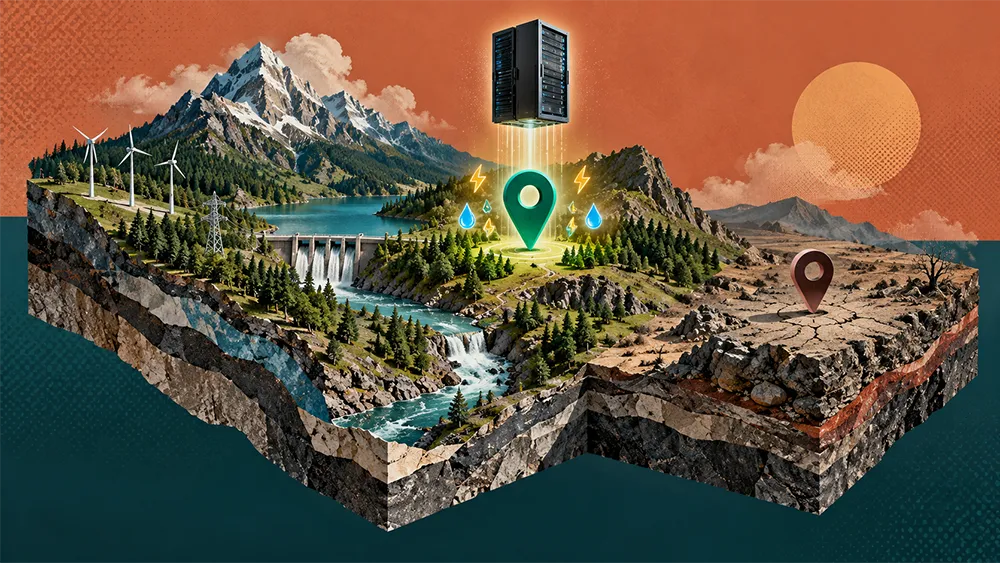

It's not just about the technology, it's about availability and price. To be the cheapest, I need to put my workloads in a place where I can have energy, cooling, and technology. All these three pieces need to work together.

A single AI data center campus can draw 20 or 100 megawatts of power, and the grid has to supply it. AI can also help manage that power. It can forecast how much a region will need and match generation to it, and it can get more out of renewable plants that would otherwise run below capacity. The question worth asking is whether the power available at a given location should help decide where a workload runs.
Fernando Faustino is Executive Advisor for Digital Transformation and AI at Grupo Souza Lima, reporting to the group presidency on IT modernization, data, and generative AI. He was previously Executive Head of IT at Sabesp, the São Paulo state sanitation company, and IT Executive Director at Grupo Petrópolis. Faustino's earlier roles span logistics, mining, energy, and software. Earlier in his career he built and ran data centers, including a Tier III facility certified by the Uptime Institute.
"'Where will I put my workloads?' will be the question of the future. It's not just about the technology, it's about availability and price. To be the cheapest, I need to put my workloads in a place where I can have energy, cooling, and technology. All these three pieces need to work together," said Faustino. Energy and cooling depend on where the data center sits, and vary between countries more than most procurement models account for.
- Producing the power: Faustino points to Brazil's sugarcane sector, where Raízen produces ethanol alongside bioenergy made from the fibrous residue left after crushing. Optimizing that residue is the kind of problem machine learning handles well, and the electricity it generates can run the same infrastructure the models sit on. "All the people that I know think that AI is a big consumer of energy," Faustino said. "I think the opposite, that AI can create algorithms that help to generate energy more efficiently."
- What hyperscalers are asking: The question of what a given workload costs in electricity has barely reached the enterprises running those workloads. Faustino sees the accounting happening at the top of the market and almost nowhere else. The largest platform companies negotiate directly with generation and distribution firms, because their model training depends on securing the supply. "The enterprises aren't thinking about how my consumption of AI will affect the energy produced," Faustino noted. "I think just the biggest ones are, because they need this to put the models to work."
Brazil makes the argument easy to see. Most of the country's electricity comes from renewable sources, with hydropower carrying the largest share and wind and solar close behind. Wind output peaks between June and November, while hydro reservoirs sit at their seasonal low. The combination has drawn hyperscale investment, including two Microsoft AI data centers that opened in January. Faustino reads the position as one Brazil has not fully claimed yet. "Here the energy is not a problem," Faustino explained. "If Brazil can be a bit smart, we can be a big market for data centers and take some of the opportunity."
- Energy enters the price: Leaders already compare cloud prices region by region when they decide where to run something. What sits behind those price differences includes the cost of electricity in each location. "When you add a machine in AWS cloud, if you put your workload in Virginia there will be one price, and if you put it in Brazil there will be another price," Faustino said. "I think that energy will be a variable of this calculation."
- Latency, residency, redundancy: Energy joins a list of constraints that already pull against each other, and Faustino hit all of them at Sabesp. Brazilian law required the data stay in the country, and the Azure regions available locally didn't give him the redundancy he needed for certain components. Running the contingency out of the United States solved redundancy and broke latency. "I talked with GCP and put the workload as a contingency to work in one region here in Brazil," Faustino said. "I had Azure and GCP working together."
Placement decisions come with too many competing constraints to settle at once, so Faustino works through them in order. Residency comes first, since data sovereignty is a legal constraint and not a preference. Redundancy follows, then consumption, and he treats consumption as three separate quantities. Price lands at the end, after the constraints have narrowed the field. "When I am talking about consumption, it is energy, water, and cooling," Faustino said. "The last one is the price. The price is either okay or not okay for me."
What convinces Faustino that power belongs in the architecture conversation and not in facilities is the scale of what a building draws. He built a data center more than fifteen years ago and remembers what it drew, before anyone was training models in one. Cooling compounds the problem, since moving and chilling water costs power of its own. "A small data center, we're talking about three megawatts, five megawatts," Faustino added. "It's too much for just one company." Those figures predate AI training entirely, and he has yet to form an estimate for where the demand settles. "I don't know when we will stop," Faustino concluded. "I don't know how we will be in five, even ten years, because AI is changing a lot of things."