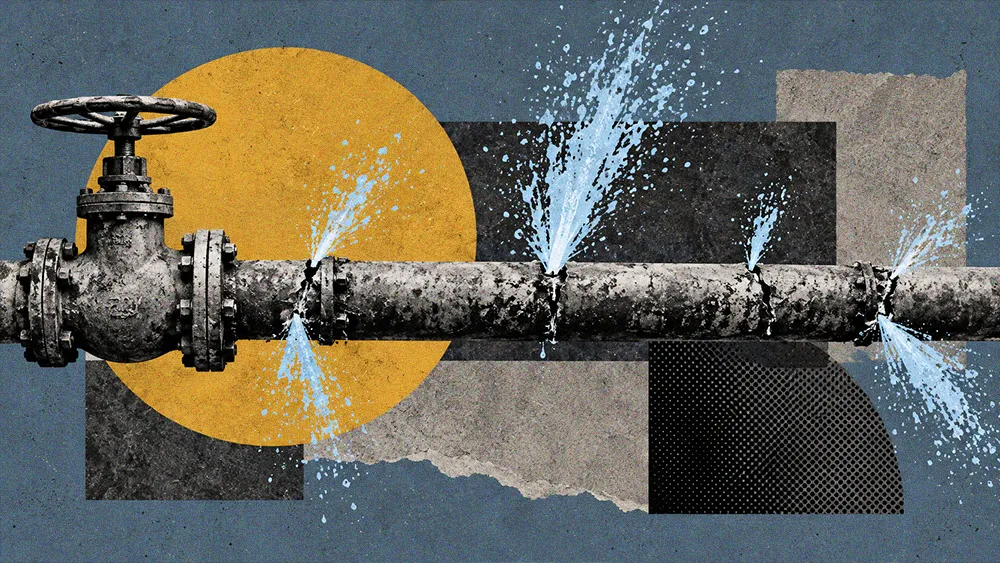

You get governed by starting with AI. It supercharges your governance because you find more holes than ever.
 Nolan WalkerVP of Business Intelligence @ Suncoast Credit Union
The standard advice for enterprise AI is to fix the data first: unify the silos, build the single source of truth, then layer intelligence on top of a clean foundation. The problem with that advice is that it describes a door no one can actually walk through. You can't see where your data is broken until you try to use it, and if you refuse to start until everything is unified, you'll never generate the knowledge that would tell you how to unify it. The way out of that loop is to start anyway and let AI show you where things actually stand.
Nolan Walker is VP of Business Intelligence at Suncoast Credit Union, one of the largest credit unions in the United States with roughly $20 billion in assets and 1.4 million members across Florida. He oversees intelligent automation, data analytics and engineering, and a dedicated AI research-and-development team, and he came up through most of those jobs himself, building the organization’s warehouse and cloud based data architecture before leading the people who run them now. That full-stack vantage shapes a view of governance that runs directly against the industry’s traditional sequencing.
"We have to attack governance as an enterprise ownership project. AI can’t succeed without it now. But that doesn’t mean AI doesn’t start without it," Walker says. "You get governed by starting with AI. It supercharges your governance because you find more holes than ever." It’s a deliberate inversion of the usual order, and it starts with how he reads the problem everyone claims to be solving.
The fragmentation loop
The conventional vocabulary around enterprise data, Walker says, is a wish list everyone recites and no one can act on. "All I hear is the buzzwords. One source of truth, unify our data, things are fragmented in silos. We all share the same vision," he says. Where he parts company with his peers is on how you get there. "You don’t know any of the fragmentation until you use it. If you’re unwilling to start until everything is unified, but you can’t understand how to unify everything until you start, do we not see the loop we’re stuck in?"
His answer is to treat the discovery of bad data as the work itself rather than a prerequisite to it. Instead of waiting for a clean estate, he wants the people closest to each dataset to get in and, as he puts it, take data quality problems personally. "So personal that you want to be part of the solution," he notes. The payoff of using data in converting anger to ownership is that every gap surfaces as a concrete, ownable fact instead of a vague complaint.
Bad data is a record of old decisions
What surfaces, in Walker’s experience, is often the fossil of a choice someone made years ago and never wrote down. He offers a glimpse into a moment he's seen play out many times. "What do you mean we didn’t collect that field when we changed systems in 2005? Well, guess what, that’s a real problem. It was a real decision that we made, and the fact that someone’s only talking about it now is another problem."
The remedy isn't to erase that history, but to capture it. Document the decision, build a solution where one exists, write an exception where it doesn’t, and move on, Walker says. The byproduct is something most organizations have never had: "a catalog of every data quality problem that exists, and you own it." That reframes lineage as more than a map of where a field came from. It becomes the institutional memory of why the data looks the way it does, the context that an analyst holds in their head and an AI system has no way to know.
His illustration is pointed: someone who never worked with a dataset puts AI on top of it, gets asked in a meeting what happened on a particular date in 2015, and can only shrug that the data must be bad. The owner who lived through the system conversion knows the real answer, and once it’s written into the organization’s ontology, so does everyone else’s AI.
Getting there requires a posture Walker frames, only half-joking, as institutional paranoia. "I always tell people, 'You should all be conspiracy theorists as we start this,'" he says. If a team has never run AI against its own data, every insight it produces should be treated as guilty until proven innocent. He describes the discipline concretely: pull up a number, check it against the report it should match, and when it’s off by two percent, flag it with a comment that shows the discrepancy and feeds the correction back in. That loop of distrust and verification, repeated across an organization for a few years, is what heals the connective tissue between AI and the data it reasons over. Skipping it, he warns, is how anyone who wanders in can do real damage.
The whole season at once
Walker’s sharpest argument is about how organizations roll AI out, and here he reaches for television. A great show, he notes, can sit on the edge of cancellation during its slow weekly release and only become a phenomenon once every season lands on a streaming service at once. "How can something like Breaking Bad be on the verge of cancellation when in its entirety it’s a masterpiece?" he points out.
The lesson he draws is that drip-feeding AI into an organization as a course here, a pilot there, lets interest fade before momentum builds. The alternative is to get the most capable and motivated people to find the deficiencies first, then release the capability broadly once it’s proven, dropping all eight seasons at once rather than rationing the show until the audience drifts away.
You own the definition
The engine underneath all of this is ownership of definitions, and Walker enforces it deliberately. He builds his AI systems to answer hyper-simple, governed questions rather than open-ended ones. Instead of asking a model to work out what a workout loan or a delinquency is, he reduces each to a governed column, is-delinquent, is-workout, with an approved definition behind it. When someone asks for a field that isn’t there, the answer is a transaction. "How do you define it? Where is it governed? You now own the definition, and when you get it approved, I’ll code it," he says. "I deliberately skinny down the available data to very governed information."
He holds that line for a structural reason, not a bureaucratic one. The moment definitions get created ad hoc across the organization, governance is lost for good. "If we go making fragmented definitions across the org, we never become governed." Tying every new field to an owner and an approved definition is what he calls the carrot that pulls an organization toward governance, and the governed estate on the other side is what finally makes AI fast. As he puts it, that governed information "gives us supreme speed with AI."
The views and opinions expressed are those of Nolan Walker and do not represent the official policy or position of any organization.