

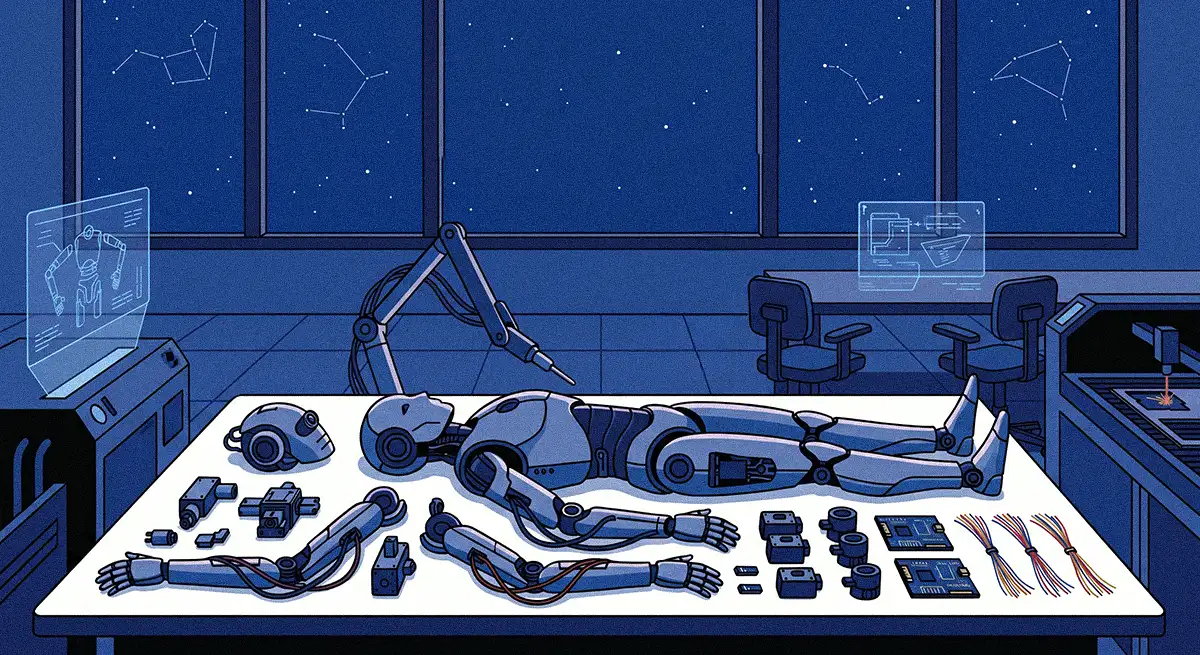
There is no integrated developer environment in robotics. There are just separate software tools.
 Rangel AlvaradoRobotics & AI Engineer @ Data Acquisition Systems, S.A.
Physical AI today still resembles pre-cloud enterprise development: fragmented tooling, disconnected pipelines, brittle integrations, and highly manual deployment processes. Robotics engineers bounce between simulators, training environments, sensor stacks, inference systems, calibration tools, and hardware-specific controllers with no equivalent of a unified modern development environment.
The implications go well beyond developer convenience.
Rangel Alvarado is a Panama-based robotics and AI engineer with more than 17 years of experience spanning embedded systems and industrial automation. He led test and commissioning work on heavy-duty projects including the Panama Canal Expansion and the Tocumen International Airport Expansion, and currently works in the financial sector alongside running his own firm, Data Acquisition Systems, S.A. An Associate Professor of Robotics and AI at Universidad Latina de Panamá, Alvarado brings a trench-level perspective on how physical AI behaves once it leaves the lab. Having built generative AI tools and commissioned medium-voltage industrial equipment, he knows exactly what happens when theoretical models hit physical steel.
"There is no integrated developer environment in robotics. There are just separate software tools," Alvarado says. An IDE could help push robotics into an unprecedented boom. App development exploded after standardized IDEs, APIs, package managers, and cloud platforms collapsed complexity into reusable workflows. Physical AI may be approaching a similar transition as the industry converges on the idea of robots as software-defined systems first and hardware products second.
The new architecture rewriting robotics software
Underneath the IDE problem is an architectural shift that explains why robotics is starting to look like a software discipline at all. The most advanced humanoid models are no longer single-purpose controllers. They are moving toward end-to-end neural architectures that unify perception, planning, and control into a single learned policy.
NVIDIA's GR00T N1 foundation model illustrates this integration, where visual, linguistic, and environmental context are processed concurrently to map directly to continuous motor commands. Rather than relying on discrete, human-defined layers of 'reasoning' and 'action,' these VLA models map high-level semantic intent into continuous motion through a unified transformer-based backbone. This removes the need for manual, hand-coded links between what a robot sees and how it moves.
Alvarado describes the same structure from the developer's seat. "For engineers, this means moving away from brittle, monolithic, task-specific code paths toward an architecture where the entire stack is treated as a continuous, end-to-end learning problem." The 'reasoning' and 'motor control' are no longer separate, coupled modules, but rather emerging properties of a single, generalized intelligence.
The shift is more profound than it sounds. Traditionally, perception, planning, and control were fused into separate, task-specific code paths. Current end-to-end architectures unify these domains; success is no longer defined by writing discrete logic, but by the model’s ability to map raw data to movement through one continuous policy. The entire pipeline is now that learned model.
Developer tooling as the bottleneck
The most important battle in humanoid robotics may not be humanoid hardware itself but instead the race to build a unified orchestration layer beneath it. NVIDIA is rapidly assembling something close to that stack through its Isaac ecosystem, Omniverse simulation platform, Cosmos world models, GR00T foundation models, orchestration tooling, and synthetic data pipelines.
The interesting shift is not merely that these tools exist. It is that they are starting to collapse traditionally separate robotics disciplines into a continuous software pipeline: simulation; synthetic data generation; model training; deployment; telemetry; observability; post-training adaptation; and real-world validation. That starts to look less like traditional robotics and more like modern DevOps.
Andreessen Horowitz recently said "the robotics equivalent of DevOps practices doesn't exist yet." That may become one of the defining infrastructure problems of physical AI. The reason is simple: embodied AI systems do not fail like software. A broken SaaS deployment crashes an application, but a broken robotics deployment can physically destroy machinery.
"A payload of the software could break your hardware," says Alvarado. "It will fail and break the machine or the robot." That changes the operational model.
Physical AI is creating infrastructure teams for machines with bodies
Demo footage masks how big the operational gap actually is. Alvarado is blunt about the mismatch. "The videos that they show us, they are constrained to a clean environment. Some things a little bit messy, but the real world is real messy," he says. His cautionary parallel is self-driving cars, where a decade of keynote promises has yet to produce true full autonomy on public roads because the open world has "infinite possibilities" that controlled environments do not. Humanoid robotics inherits the same problem with a body attached.
The emerging robotics stack is forcing a collision between disciplines that historically operated separately, including AI engineering; embedded systems; observability; simulation; mechanical systems; and industrial operations. Modern cloud systems already require SREs, DevOps engineers, observability platforms, rollback systems, and continuous deployment safeguards. Physical AI introduces all of those requirements while adding kinetic risk.
A model trained in simulation may behave unpredictably in real-world environments, where sensors drift, simulations diverge from reality, calibration degrades, timing desynchronizes, and actuator tolerances shift. Even basic sensor fusion becomes nontrivial. As Alvarado explains, robotics teams must continuously synchronize data streams arriving at different frequencies while filtering outliers before feeding that data into VLA systems. "You always need to calibrate your sensor," he says. "Even your articulators need to be calibrated."
Teams handling the sim-to-real gap are converging on a pipeline that has more in common with iterative software deployment than with traditional robotics validation. Alvarado favors what robotics teams call real-to-sim-to-real: capture real-world sensor data first, simulate against it, then redeploy to the physical robot. Simulators, he says, are "just a representation or abstraction of our real world," useful as approximations but not substitutes. The final model almost always needs fine-tuning on the actual hardware in the field.
That operational burden is beginning to resemble an entirely new engineering category: infrastructure for embodied systems.
A 2025 survey on Embedded DevOps argued that embedded and hardware-linked AI systems require fundamentally different deployment, observability, and CI/CD practices than cloud-native software because of hardware dependency and safety-critical constraints. Meanwhile, robotics researchers are increasingly adopting microservice architectures and containerized deployment pipelines to bring cloud-style operational practices into robotics environments. The surprising part is how quickly this stack is starting to resemble mainstream software infrastructure.
VLA models push robotics toward a software-defined future
The architectural shift compounds. Traditional industrial robotics depended heavily on deterministic programming and tightly constrained environments. Vision-Language-Action models move in the opposite direction. Instead of hard-coding tasks, developers train systems that interpret visual input, language instructions, and environmental context, then generate action sequences dynamically. NVIDIA's GR00T initiative explicitly frames this as the arrival of "generalist robotics."
That changes where the engineering problem actually lives. For years, robotics was treated primarily as a hardware problem. Increasingly, the industry is treating robotics as a systems infrastructure problem: data pipelines, simulation realism, orchestration, deployment tooling, synthetic environments, and model adaptation. A recent VLA research survey argued that future progress may depend "less on model architecture and more on the co-design of high-fidelity data engines and structured evaluation protocols."
The most important work in physical AI is now happening in simulation engines, synthetic data factories, deployment frameworks, and observability stacks.
The 2008 cloud transition didn't start with applications; it started with the tooling that made applications possible. Physical AI sits at the same inflection, and Alvarado puts robust general-purpose humanoids 15 to 20 years out from becoming affordable, reliable, and accessible for everyone. But the companies that win that decade will be the ones collapsing simulation, training, deployment, and observability into the single development surface he likens to "something like an app store for models." Anyone still treating humanoids as a hardware race may find they were running the wrong one.
The views and opinions expressed are those of Rangel Alvarado and do not represent the official policy or position of any organization.