
Kubernetes Becomes The Enterprise Standard As Storage Catches Up To AI Demand
Greg Muscarella, GM of Portworx at Everpure, explains why storage, not compute or networking, is the constraint holding enterprises back as Kubernetes absorbs virtualized, containerized, and AI workloads onto a single platform.
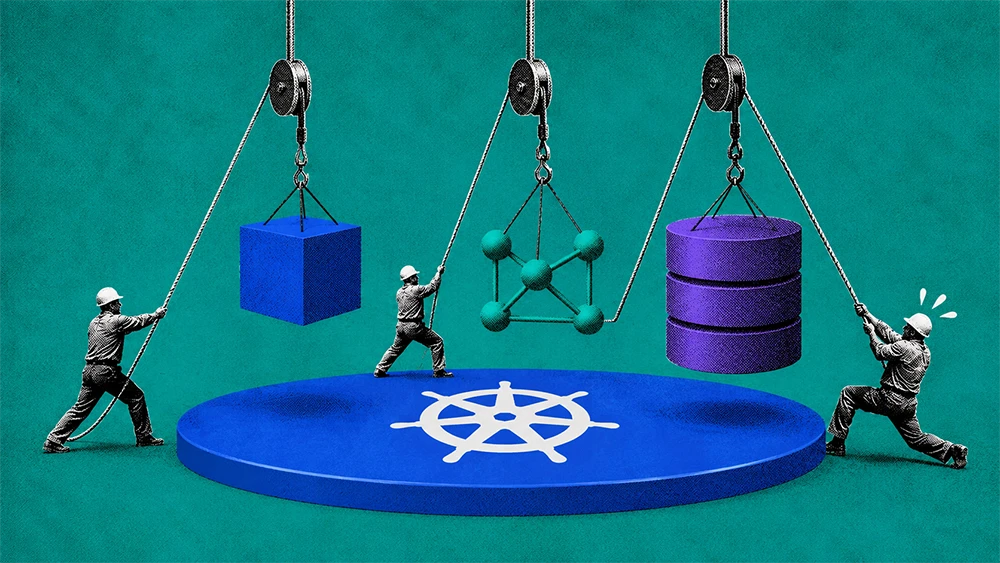

Organizations are growing and expanding both their virtualized workloads and, increasingly, their containerized workloads. They want a unified platform, at least a single platform that they can use to run both of these.

Kubernetes is absorbing workloads from every direction. Virtual machines once locked into legacy hypervisors, containerized microservices, and an expanding wave of AI applications are all landing on the same platform. Compute orchestration and networking have kept pace with that convergence. Storage has not.
Greg Muscarella is GM of Portworx, Everpure's cloud-native storage business unit. A career product and general management executive with stints leading business units at Nutanix, SUSE's Rancher, Veritas, and Symantec, Muscarella brings deep technical experience across Kubernetes, virtualization, and enterprise infrastructure. He frames storage as the defining constraint in whether enterprises can actually deliver on the promise of a unified platform.
"Organizations are growing and expanding both their virtualized workloads and, increasingly, their containerized workloads. They want a unified platform, at least a single platform that they can use to run both of these. AI workloads are one of the big ones that are really causing a lot of demand to increase on the containerized side as well," says Muscarella.
Data carries weight that compute and networking do not
The convergence is accelerating. Kubernetes production use hit 82% in 2025 according to CNCF's annual survey, and the platform now handles virtual machines alongside containers as enterprises push to consolidate onto a single infrastructure layer. But while compute and networking translate well to Kubernetes, storage carries inherent friction.
Muscarella uses a simple analogy to explain why. "As anyone who's wanted to download a movie from Netflix before their flight knows, it takes too long," he says. "Compute things basically run everywhere. But that mass of data has what makes the challenge a lot more difficult to address."
Volumes get trapped on specific arrays, capacity runs out and requires manual intervention, and IOPS overloads force administrators to rebalance workloads by hand. Portworx abstracts that layer, automating volume expansion, workload migration, and performance balancing natively within Kubernetes and platforms like Red Hat OpenShift.
AI agents are multiplying the data problem
AI is compounding the pressure. Muscarella breaks the storage challenge into three parts: training, which most enterprises skip beyond some fine-tuning; inference, which creates its own demands at scale; and context retrieval, which he identifies as the overlooked driver.
"To get real value out of your AI application, it has to have access to your emails, your Slack messages, your PowerPoints, your Google Sheets," Muscarella says. Every agent query requires finding, indexing, and ingesting scattered data, whether it is a transcript, a chat log, or a product manual.
That indexing layer creates an architecture challenge that sits upstream of inference and exposes how fragmented enterprise data remains. And the consumption is growing fast. "Your usage of data is going to look minimal compared to what your several agents running in the background are going to be using," Muscarella says. "The load is going up exponentially."
The cultural shift matters as much as the technical one
Beyond storage, Muscarella points to a cultural challenge that determines whether enterprises capture the operational gains Kubernetes offers. Legacy virtualization grew up around what he calls "click ops," where administrators name, monitor, and manually update individual VMs through a GUI. That approach produces a low administrator-to-machine ratio. Kubernetes inverts the model, managing workloads en masse by policy.
"I may have 1,000. I change a single configuration, and it applies," he says. "My concern is that people try to bring the old style of one-by-one management over with their virtual machines into the Kubernetes realm." Organizations that make the shift report significant efficiency gains. Those who resist end up running a modern platform with legacy habits.
The migration itself is still maturing. Muscarella estimates 80% of VM workloads move without significant issues, but the remaining edge cases, legacy Windows workloads, old drivers, application data format conversions, expose the fact that Kubernetes was not originally built for virtual machines. That maturation is ongoing, even as AI infrastructure investment surges and data center power consumption doubles under the weight of new demand.
Success, in Muscarella's framing, comes down to three things: uptime and performance as table stakes, portability between on-prem and cloud without significant rework, and the capacity to absorb new workloads as AI-driven infrastructure demands scale.
"Computers and applications are tremendously powerful, and now that we're able to write software faster, we want more of it, and we're using more of it," Muscarella says. "Performance, reliability, uptime, and then scaling out to handle more applications or more usage of those applications."