
Industrial AI Readiness Starts at the Sensor and Most Organizations Are Not There Yet
Oliver Inseal, Divisional NPD Engineering Manager at Parker Hannifin, explains why industrial AI is only as trustworthy as the physical sensor producing the data underneath it.
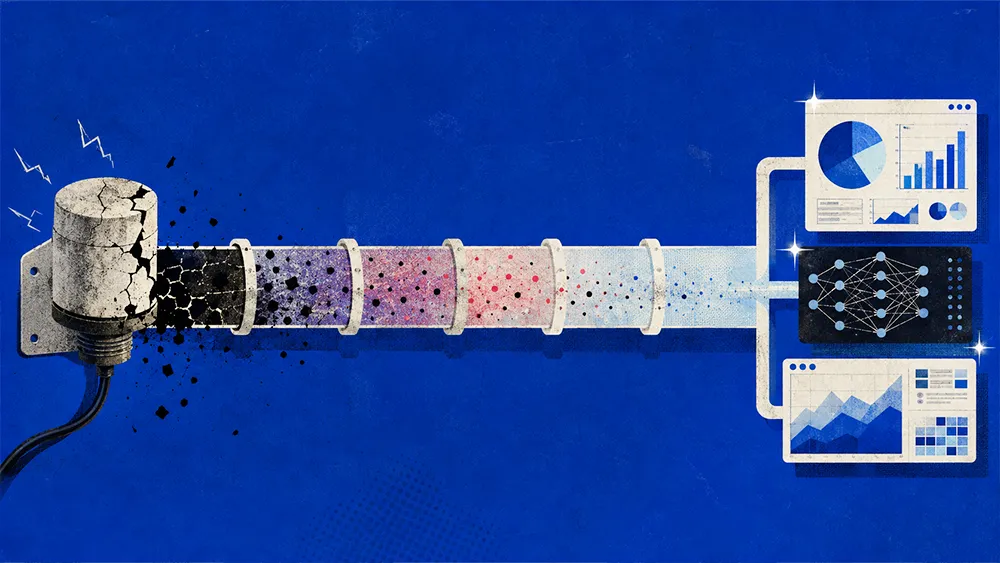

At the end of the day, the heart of it is always going to be the sensor and the reliability of that sensor. If that's off, all your data's off. You're only as good as your data, and to be as good as your data, you need sound hardware.

The conversation around industrial AI tends to focus on the intelligence layer: smarter analytics, predictive maintenance, automated decision systems built on streaming data. But in condition monitoring for marine engines, the bottleneck is not the algorithm. It is whether the physical sensor can produce measurements that are clean, stable, and repeatable enough for anyone to trust what comes after it. Without that, every downstream system fails at the source.
Oliver Inseal, Divisional NPD Engineering Manager at Parker Hannifin, leads new product development for the condition monitoring team, which is part of Parker’s Hydraulic Industrial Filtration Europe (HIFE) Division. His team designs and validates sensors for marine, hydraulic, and industrial applications, with a current focus on continuous online wear monitoring for two-stroke marine engines. Inseal is a Chartered Engineer with over 20 years of experience in sensor development across marine, pharmaceutical, aviation, and petrochemical industries.
"At the end of the day, the heart of it is always going to be the sensor and the reliability of that sensor. If that's off, all your data's off. You're only as good as your data, and to be as good as your data, you need sound hardware," says Inseal.
A decade to get online
The marine industry's transition from offline measurement to continuous monitoring has taken roughly a decade of engineering work. Operators historically sent oil samples to labs or relied on periodic offline analysis. That process was slow by design, and maintenance was reactive by default. Inseal says the shift has been gradual and challenging, but the recent launch of Parker’s Online FWM (Ferrous Wear Meter) sensor is expected to accelerate this transition.
"There are a lot of legacy products, very archaic products that people don't want to move away from because it's bread and butter. We're now having to try to change that mindset. Condition monitoring is a hard sell. Why do I need to invest in this? Well, it's going to potentially save you half a million on cylinder liners. But until it happens, there's no reality."
The engineering challenge is that accuracy alone does not solve the problem. When measuring parts-per-million iron content in oil, there is no universal "right" number. An older engine might run at 90 ppm while a newer one sits at 5 ppm. Neither is wrong.
"The chief engineers are just looking at this data to say, if all of a sudden you get a spike, something has changed. Go and investigate. Maybe you've got a new fuel on board, maybe a different cylinder lubrication oil, maybe a different flow rate." The value comes from trending against established baselines, not from hitting a predetermined threshold. Every application is different.
Hardware first, intelligence later
Inseal is clear about where Parker's core competency sits. The company designs, develops, and manufactures condition monitoring instrumentation and sensors. The software and interpretation layer is a different problem that Parker supports through partnerships rather than building in-house. Major marine OEMs are already exploring how to integrate sensor outputs into engine management control systems, where rising PPM measurements could automatically adjust cylinder lubrication flow rates.
"They want to develop their own control software where this is feeding in. They can integrate it by CANopen industrial standard protocol and write software around our sensors so it becomes a smart sensor. But that's not our skill set."
Parker has developed companion software that lets users define their own warning levels, recognizing that bespoke thresholds are necessary given how much applications vary. But Inseal positions that as a support tool, not the product. "The customer just wants to know: when do I need to stop? How long have I got left? That's the next step."
Zero defects as the real AI prerequisite
Inseal frames zero-defect engineering as the actual prerequisite for industrial AI readiness, not smarter models or better platforms. If the sensor is blocked, chemically incompatible, affected by electronic noise, or producing inconsistent measurements, the entire data infrastructure collapses. "If one of those fails, you have no product. Everything falls down."
His team follows robust product development lifecycles to ensure thorough product validation and has invested heavily in process automation, including fully automated calibration, leak testing, and laser marking, in support of zero-defect principles. "What does a customer want? They want performance, accuracy, repeatability, reproducibility, and confidence in the product’s functionality and service life. Ideally, we just want to install this, and they never have to think about it again."
On AI's role in his own engineering process, Inseal is measured. AI is a tool, useful in the right context but not transformative for the kind of bespoke, low-volume sensor development his team does. "AI coming along and supporting us, it's only a tool at this present time. I'm still figuring out where it sits with what we do."
The constraint on industrial intelligence is not the software sitting above the data. It is whether the physical signal underneath is trustworthy enough to build on. "You're only as good as your data. And to be as good as your data, you need sound hardware."