
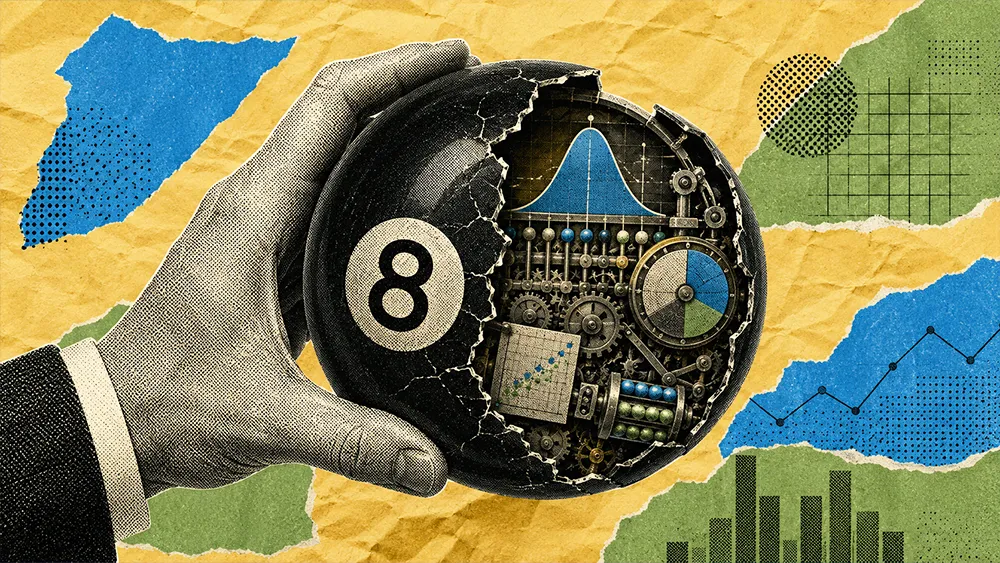
AI and many of these machine learning tools run on a statistical engine. That's what's really happening under the hood. To use it effectively, safely, and responsibly, you want to know more about what's happening under the hood.
 David Corliss, PhDPrincipal Data Scientist @ Grafham Analytics
AI is forcing enterprises to get comfortable with answers that arrive in probabilities, not absolutes. As businesses race to bring these tools into daily operations, they’re running into a cultural mismatch: leaders want clean yes-or-no decisions, while AI models work in statistical ranges, confidence levels, and educated uncertainty. The path forward requires operations where domain experts and data scientists work together to understand what the model knows, where it’s estimating, and what happens when it gets things wrong.
David Corliss, PhD, is Principal Data Scientist at Grafham Analytics, where he helps organizations apply statistical and AI-driven methods to real-world business problems. His perspective is shaped by more than two decades leading data science teams at Stellantis, Ford Motor Company, and DTE Energy, along with work as an astrophysicist and statistical expert witness. We spoke with Corliss about how the mathematical reality of AI plays out in everyday forecasting and industrial operations.
To get real value from AI, he says organizations need to stop treating it like a magic 8 ball and start treating it for what it actually is: a statistical tool. "AI and many of these machine learning tools run on a statistical engine," says Corliss. "That's what's really happening under the hood. To use it effectively, safely, and responsibly, you want to know more about what's happening under the hood."
A margin for error
The root of the friction usually comes down to math. Leaders accustomed to spreadsheet certainty expect a definitive answer, but AI rarely delivers one. Instead, it operates with an inherent probabilistic fuzziness, and a good statistician typically provides two answers: the number itself and the reliability range of that number. "A lot of folks on the business side don't have that background to deal with stochastic things," Corliss says. "But that is exactly the area of expertise for data scientists."
Citing the well-known statistician George Box, he notes that while all models are wrong to some extent, some are useful for forecasting and approximating, not as facts to act on. "If I say you're going to sell 342 widgets, it doesn't mean you're going to sell 342 widgets," he says. "It means it's going to be maybe this side of 342. So you want to be aware: What are the risks? What do you do when it goes wrong? How do you tell?" Without that contextual oversight, the math behind these tools can create expensive headaches. Quantitative errors often trigger an immediate sanity check, as a manager quickly sees that a forecast of 342 widget sales is unlikely if the business has never sold more than 80 in a month.
Qualitative and text-based outputs, though, strip away those obvious numerical baselines. If an HR screening tool or a sentiment analysis program misreads the tone of a customer review, untrained users might easily miss the mistake. "AI is just a tool," Corliss says. "It isn't good or bad. It's got strengths and weaknesses, but it needs to have folks riding shotgun on it."
The AI learner's permit
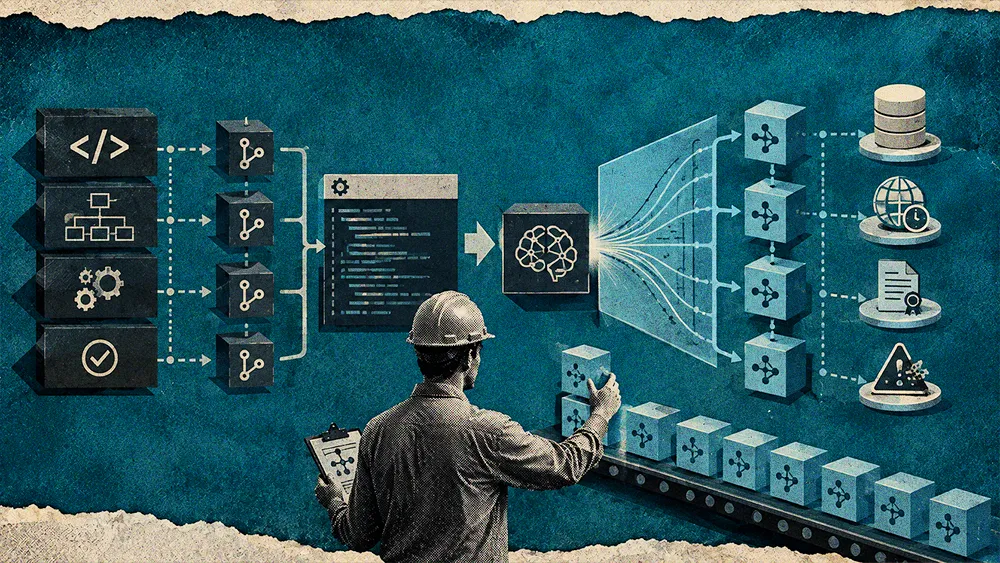
Rather than writing off the technology, Corliss uses these failure modes to build a practical case for a learner's permit approach. In his experience, the easiest way to sidestep these pitfalls is to let everyday users test tools under the supervision of domain experts before handing over the keys. This kind of collaborative oversight is already working in production. On Chrysler engine assembly lines, for instance, Corliss highlights how inspectors photograph completed engines in a dedicated booth, and defect detection improves when human inspectors and AI work together, each catching mistakes the other misses.
"We're not asking people to become data scientists," Corliss says. "We're asking people to become better partners with data scientists." A seasoned data scientist must routinely weigh the value of historical data against the relevance of recent business changes to make sure a model reflects current reality. Because of these nuances, effective deployments often begin with a conversation about the business before anyone touches the algorithms.
Trust beats training
Moving carefully can sometimes create friction around enterprise AI adoption. But Corliss bypasses that organizational drag by empowering early grassroots champions to test the tools and share both their successes and failures. Honesty about what doesn't work is exactly what builds the cross-functional trust required to make the technology genuinely useful. "Effective AI is built on the science, but it's even more built on relationships of trust between customers, business leaders, people who are running programs, and the data scientists," he says.
Corliss points to one high-value example of that collaboration in action. "People are taking pictures of airplanes and finding cracks you can only find with a microscope," he says, noting that AI supports experts by showing them where to look. "You don't know where to put the microscope."
To scale those wins, Corliss has found that the best approach is simply finding internal champions and letting them lead. "The way you drive adoption of AI that really works is you find a couple of people who are doing a really good job of it and let them tell their story," he says.
In the end, AI isn't magic. The tools might be new, but the playbook is familiar: understand the data, know the limits of the math, and make sure the people running the business work closely with the people building the models. As Corliss puts it, "Some models are very useful, but you want to be aware of what the risks are. What do you do when it goes wrong? How do you tell? Having that relationship with the data scientists is going to make that work."