
As AI moves from behind-the-scenes operations to customer-facing experiences, brands must think beyond automation and design adaptive, emotionally engaging experiences.
 Doug AguiarMarketing Consultant @ former CMO @ Golden 1 Credit Union
Disney's Olaf demo at NVIDIA GTC shows what happens when physical AI stops being an efficiency tool and becomes a customer experience. A virtual character interacts with a real person in a real environment without any wearable hardware. The experience is adaptive, emotionally responsive, and memorable.
It is also the product of three strategic partnerships working in parallel: NVIDIA supplies the physics layer, DeepMind supplies the adaptive intelligence, and Disney supplies the emotional storytelling. The demo itself was imperfect, and it points to where embodied brand experiences are heading. Platforms like NVIDIA Omniverse, a simulation and digital twin “sandbox” that allows organizations to build, test, and train AI-powered environments in a virtual world, are beginning to make that capability more accessible.
Doug Aguiar, former SVP and CMO of Golden 1 Credit Union, spent eight years leading marketing, communications, product development, and digital transformation for a top-ten US credit union. Under his leadership, membership grew 66% to 1.1 million, assets increased 125% to $22.5 billion, and the brand earned national awards from Fast Company and American Banker. A Journalism graduate from the University of Southern California, he holds an Executive MBA from the University of Washington Foster School of Business and a Harvard digital marketing certificate. He currently serves as Board President of Stanford Sierra Youth & Families.
"Branding is really about the emotional connection, and people remember experiences that are emotional, personalized, and differentiated. If you can find one or two things where you can differentiate what you're doing in a way that is consistent and authentic with your brand purpose, that's a great start," says Aguiar.
From back office to front line
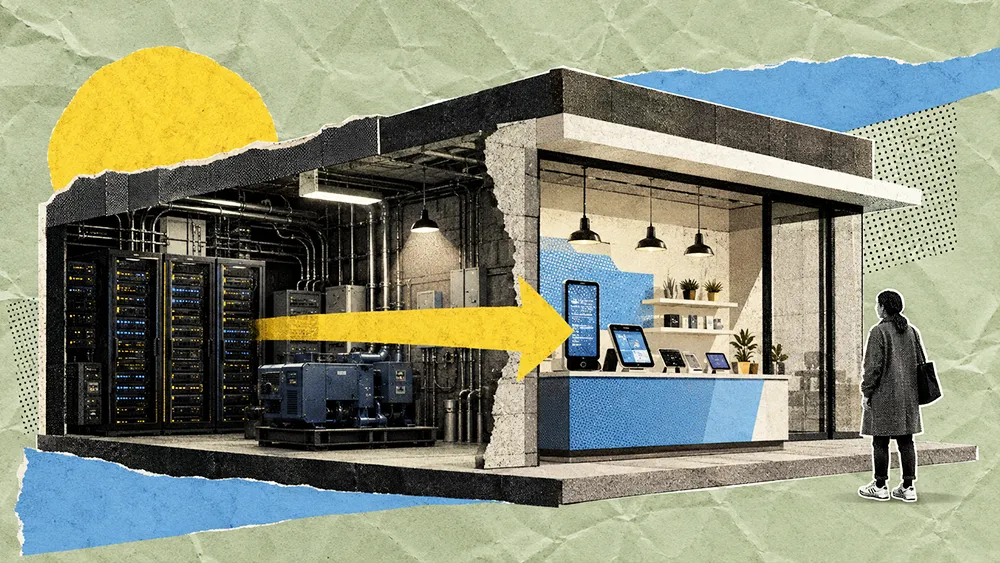
Aguiar frames physical AI as an evolution, not a revolution. The technologies that now power adaptive customer experiences began as internal efficiency tools. Touch screens, voice assistants, and chatbots started as infrastructure. They are now reshaping the customer-facing layer. "What began as technology to create efficiencies is now evolving into a customer experience infrastructure."
He points to Lowe's and its MyLowe's platform as an example of a retailer moving from operationally intelligent to customer-facing adaptive. Rather than treating each visit as a new interaction, the platform adapts the customer’s experiences based on “jobs to be done,” preferences, and purchase history. The store environment itself is becoming a responsive, data-aware interface that answers questions like what the customer is trying to accomplish, what is happening in the store right now (e.g., special promotions, DIY seminars, etc.), and how the brand can adapt in real time.
"Previously, they were using some of the same technology internally for restocking shelves, training employees, and tracking inventory. Now the evolution is moving those operational capabilities to the frontline."
Figure's humanoid robots working at human speed on assembly lines represent another signal. Aguiar sees the trajectory moving from industrial reliability into broader human-facing use cases like the growing need for elder care. "These robots are more reliable than humans and currently match their speed and productivity. That's the start of this evolution from assembly line to environments that respond to people."
Purpose before technology
For companies preparing to deploy physical or embodied AI, Aguiar is direct: do not start with the technology. Start with purpose. "It just doesn't start with a robot. You need to make sure you have your experience architecture buttoned up, and then your context with the real-time data."
That means getting data foundations in order first. CRM and CDP infrastructure serve as the nervous system. Customer journeys and behavioral data need to be clean enough to support personalization.
Early pilots should be narrow and low-risk: a concierge agent, a new customer onboarding flow, or a single adaptive experience within an existing physical environment. "Stop thinking about it as a set of tools and more about an adaptive brand system with customer content, emotional and behavioral design."
He also advocates for partnerships outside the organization's own industry. Cross-industry learning accelerates strategy. "Don't just look within your own industry. Look at other industries and how you could adapt some of those things. It could be a smaller agency. A small partner that can really help you think through some of these things."
The authenticity risk
Aguiar identifies inauthenticity as the primary risk when brands deploy embodied AI experiences. If the experience does not align with the brand's actual purpose and values, it creates a disconnect that customers recognize immediately. "What could really go wrong is if you're inauthentic. That's why it's important to start with your purpose, not with the technology."
For smaller companies without enterprise-scale resources, the advice is to avoid paralysis by narrowing scope. Pick one or two differentiated experiences that reposition the brand as modern and contemporary, then build from there. "Do one thing that has a halo on your brand. You don't have to do everything. Sometimes people think they have to do everything, and then they never start because they're just so overwhelmed."
NVIDIA Omniverse and similar simulation platforms are lowering barriers in ways that parallel what the cloud did for I.T. infrastructure. Physical AI is coming for every brand, not just the ones with Disney's budget. The companies that prepare by defining who they are and what emotional experience they want to create will be the ones ready when the tools arrive.