

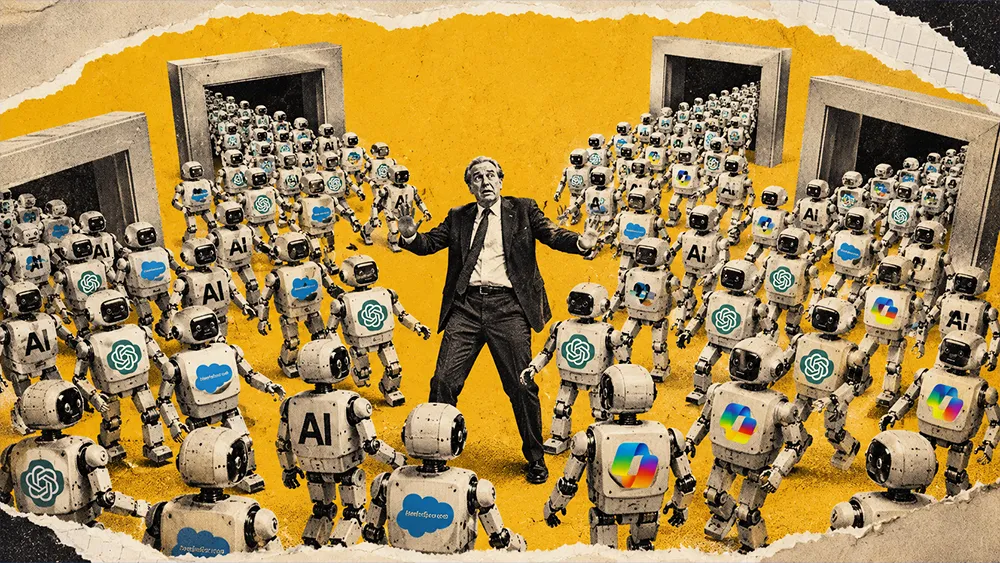
People are still thinking of agents like software. You don't give software a mission, vision, or values. Do you give humans a mission, vision, and values? Absolutely.
 William duPontCo-Founder @ Applied Identities
Stripe announced 288 agentic commerce products and told companies to get the C-suite involved in managing agentic transactions. OpenAI launched a multibillion-dollar consulting organization. Google stood up a new forward-deployed engineering division. KPMG is rebuilding global tax advisory on Anthropic. Agents are arriving in enterprise environments from every direction, and most companies have no coherent way to manage, measure, or align them.
Daniel Davenport and William duPont, Co-Founders of Applied Identities, have spent 30 years steering enterprises through technology waves, starting with one of Atlanta's first digital agencies in 1994 and moving through cloud and digital transformation for Fortune 500 brands like Coca-Cola, UPS, and Ford. They watched companies treat "we built a website" as a strategy, and they see the same mistake forming around AI agents. Recently, Davenport led GenAI and agentic go-to-market for NTT DATA's Cloud and Security division, while duPont, as Client Partner and AI Cloud Specialist, built the organizational architecture and identity frameworks that govern how agents operate. They argue that semi-autonomous AI agents must be managed like human employees, complete with onboarding, training, and cultural alignment.
"People are still thinking of agents like software. You don't give software a mission, vision, or values. Do you give humans a mission, vision, and values? Absolutely. Semi-autonomous or autonomous actors are closer to humans than software, and that is the transition that we're going through right now," says duPont.
The onslaught is ahead of the operating model
Davenport and duPont describe a flood of agents entering enterprise ecosystems from every direction. Large language model providers, Salesforce, ServiceNow, infrastructure vendors like Cisco, and observability platforms, consulting firms, and even suppliers are all deploying agents into client environments. "Everybody is going to land in clients starting now to see how fast they can push token consumption," Davenport says. "And the clients don't have a lot of people on their side right now. They don't have independent tools. They don't even have a way to talk to each other about what is going on within the C-suite."
The measurement problem compounds the confusion. Companies currently default to crude proxies like token spend or employee utilization of AI tools. Davenport points to Salesforce's "agentic work units" as an early attempt to quantify agent output differently, but says the industry is still far from a reliable framework. "You need to think about an agentic and human workforce together, about capacity and how that gets allocated. Those are the work units we need to quantify to then decompose into tokens, orchestration costs, and integrator costs to get a total cost and an ROI." He expects the CHRO, CFO, and COO to own much of this problem because it is fundamentally a workforce planning challenge, not a technology procurement decision.
Cultural training is the differentiator
duPont argues that the real competitive gap will not come from which tools a company deploys but from how those tools operate within the company's context. Anthropic ships the same generic agent primitives and the same pre-built agents to every client. So how does a generic agent become an agent that operates within the context of your organization, your employees, your customers, your suppliers?"
The answer, he argues, mirrors how companies onboard human employees. Functional training alone does not produce a productive worker. Cultural training matters. "Somebody can be technically good at their job, but if they don't fit within the culture of the company, they are not going to be productive. Right now, most people can spin up agents that do what they are designed to do. They are not doing it in the cultural context of the company they're operating in." He points to Anthropic's constitution as a template for how to think about it: a document that describes what the company does, what it stands for, how it does business, and what it does not do.
The problem scales quickly when enterprises run agents across multiple platforms like Copilot, Anthropic, OpenAI, and vendor-specific systems. Without a unifying layer, companies are renting the illusion of a workforce. "What you're really doing is renting agents that are somebody else's platform, somebody else's agent. They just put on a top hat when they come to work and pretend to be yours," says Davenport.
Davenport and duPont draw a direct parallel to the early web era. Companies that spent heavily on websites without connecting them to business functions eventually fell behind those that built digital operations with real strategy behind them. The same pattern is playing out now. Companies are cutting employees with no clear plan for how agents replace the work, measuring success by spend rather than output, and deploying generic tools without the organizational architecture to make them effective.
"If agents are like humans, they need to be onboarded, operated, and measured like humans. How the heck do we do that? That's the question everybody is asking," says duPont.